Doom on a Fridge and Other Crazy Ports: What They Taught Us
Doom has run on calculators, a pregnancy test, a tractor, a PDF file and a display made of gut bacteria. The stories are funny, but the reason they are possible is a serious lesson for anyone planning to port a game: keep the platform code small, separate and honest about the hardware.
 Krystian MlodziejewskiBusiness & Relations Director
"But can it run Doom?"
It is probably the most famous question in porting history. For more than thirty years, people have been putting id Software's 1993 shooter on things that were never meant to run a game - and every time, the internet answers the same way: apparently, yes.
I love these stories. Some of them are genuine engineering, some of them are cheeky tricks, and a few are both. But the more interesting question is not where Doom has run. It is why it can run almost anywhere - because the answer is exactly what makes any game easy or hard to port today.
The most memorable answers to "can it run Doom?"
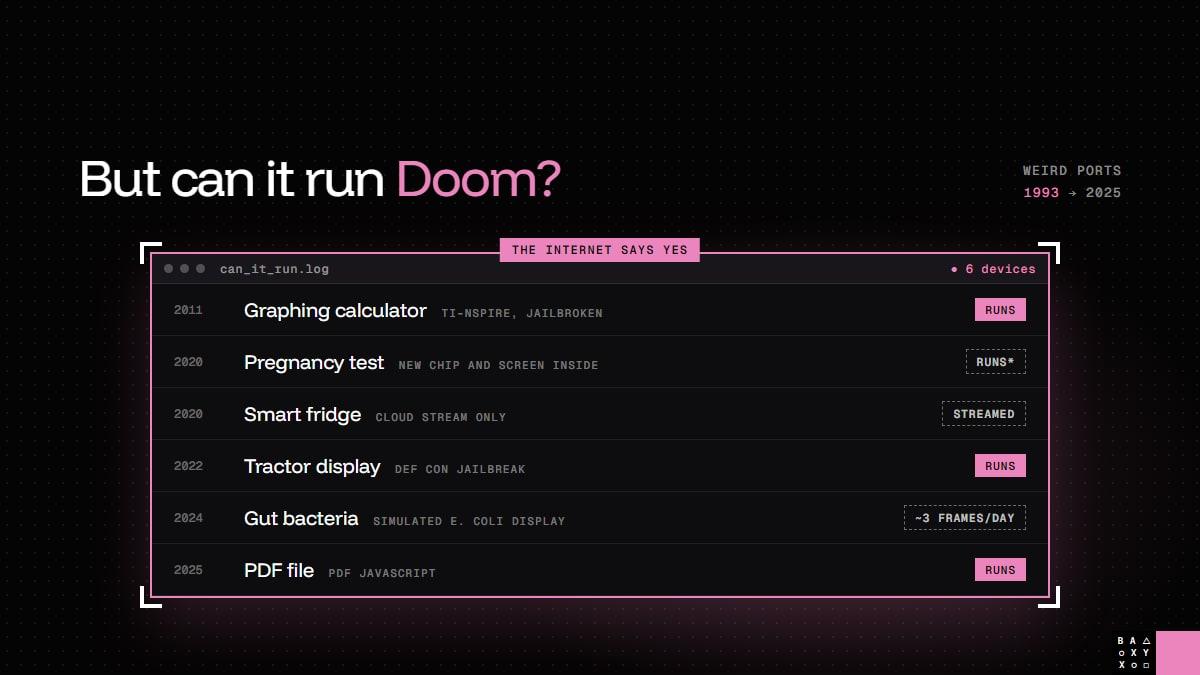
A graphing calculator (2011). nDoom brought the original game to Texas Instruments' TI-Nspire calculators, and a colour version for the TI-Nspire CX followed a year later. It needs a community jailbreak called Ndless to run native code, but after that, it is the real game on a device built for algebra homework.
A pregnancy test (2020). The hardware hacker Foone showed Doom on the tiny screen of a digital pregnancy test. To be fair - and Foone was upfront about it - only the plastic shell was original. The test's own chip could not be reprogrammed and its display could show just a few symbols, so both were replaced with a small microcontroller board and an OLED screen.
A smart fridge (2020). The headline in the title is a little cheeky. A Samsung Family Hub fridge did show Doom Eternal, but it was streaming the game through Xbox cloud gaming from a phone nearby. The fridge was a screen, not a gaming machine - which is a useful distinction we will come back to.
A John Deere tractor (DEF CON 2022). The security researcher Sick Codes jailbroke the touchscreen console of a John Deere tractor and ran a farm-themed version of Doom on it. The point of the talk was right to repair - gaining control of the machine's computer - and Doom was the proof.
Gut bacteria (2024). MIT researcher Lauren Ramlan modelled a 32 x 48 pixel display made of bioluminescent E. coli. The cells take around 70 minutes to light up for one frame and hours to reset, so the "frame rate" is roughly three frames per day. By her estimate, finishing the game would take about 600 years. A normal computer still runs the game; the bacteria are the screen.
A PDF file (2025). DoomPDF runs the game inside a PDF document, using the JavaScript that the PDF format allows. It draws the picture as rows of text fields filled with characters, runs only in Chromium-based browsers, and has no sound - but it is the actual game, compiled for a place no one expected.
What these ports have in common
Look at the list again and you will notice a pattern. In almost every case, nobody rewrote Doom. The game's logic - the monsters, the maps, the shooting - stayed the same. What changed was a thin layer underneath: how a frame reaches a screen, how a key press reaches the game, how time is measured.
That is not luck. It is how the engine was built.
Lesson 1: The source is available
id Software released the Doom source code on December 23, 1997, first under a non-commercial licence, and re-licensed it under the GNU GPL in 1999. Since then, anyone can read it, learn from it and adapt it - and ports like the ones above build on that public code instead of starting from scratch.
For a studio today: you will not open-source your game, and you should not. But the same principle applies inside a porting project. A porting partner can only plan accurately when they can see the code and the build pipeline. That is why every port we do starts with a technical review of the repository - the expensive surprises are in the code, not in the trailer.
Lesson 2: The platform code is small and separate
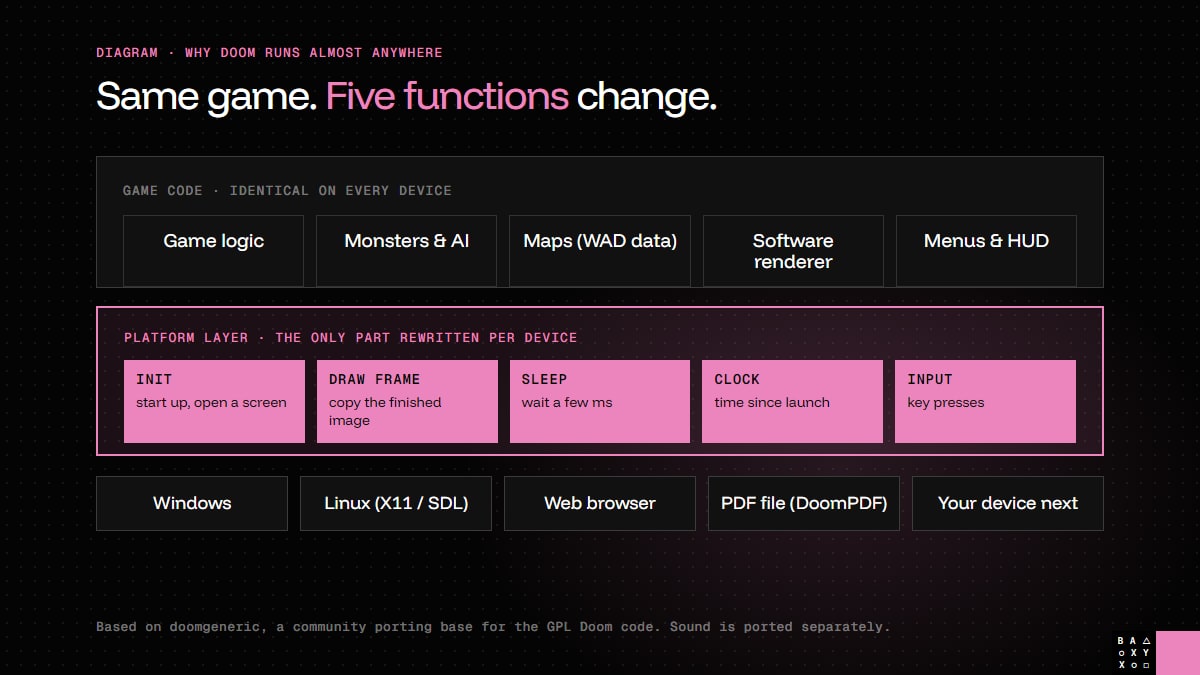
Doom keeps everything that talks to the hardware in a small set of files - in the released source they start with i_, for "interface": video, sound, system and networking. The rest of the game never talks to the hardware directly.
The community took this idea even further. A popular porting base called doomgeneric reduces a new platform to five functions: start up, draw a finished frame, sleep for a few milliseconds, report the time and report key presses. Implement those five, and the game runs. DoomPDF, for example, is built on doomgeneric.
For a studio today: this is the single biggest factor in how much a console port costs. When rendering, input, saves, storage and online services are hidden behind a clean platform layer, a new console means rewriting that layer. When platform calls are scattered across gameplay code - a Windows file path in the save system, a mouse cursor assumed in the menus, a storefront SDK called from fifty places - every one of them has to be found and fixed. Both kinds of codebases exist, and the difference in effort can be large.
Lesson 3: It assumes very little about the hardware
Doom was designed for early-1990s PCs: a 386 processor and 4 MB of RAM. It does its maths with fixed-point integers instead of floating-point hardware, and it needs nothing more than a framebuffer to draw into. Machines that can do that are everywhere now - which is why a tractor display or a calculator can run it.
For a studio today: the equivalent is being honest about what your game takes for granted. Does it assume 16 GB of RAM, an SSD, a keyboard, a mouse, a 1080p monitor, a constant internet connection? Each assumption is fine on PC and becomes a task on a console or a handheld - from memory budgets on Nintendo Switch to controller-first menus and suspend-and-resume. The fewer hidden assumptions, the further your game travels.
And the fridge?
The fridge story teaches the opposite lesson, and it is just as useful. Streaming a game to a screen is not porting it. Cloud play puts a game on more screens without changing a line of code, but performance, input lag and the platform's own requirements stay someone else's problem. A real port means the game runs natively, meets the platform holder's certification requirements and feels like it was made for that device.
Your game doesn't need to run on a fridge
PS5, Xbox and Switch 2 will do. And the good news is that you don't need Doom's thirty-year community to get there. If your platform code is reasonably contained and your hardware assumptions are known, a console port is a project with a clear scope and a fixed price. If they are not - which is normal for games built for one platform first - that is exactly what a porting partner is for: finding those places early and putting them behind a clean layer.
If you want to know how portable your game is, send us the details. You get a free first estimate within 3 business days - no tractor jailbreak required.
And I would love to hear it: what is the weirdest place you have seen Doom run?
Frequently Asked Questions
Why can Doom run on almost anything?
Three reasons: its source code has been public since 1997 (under the GPL since 1999), its hardware-specific code is small and kept separate from the game logic, and it was designed for very modest hardware - a 386 processor and 4 MB of RAM - using fixed-point maths.
Did Doom really run on a pregnancy test?
Only partly. In 2020 the hardware hacker Foone showed Doom inside the shell of a digital pregnancy test, but the original chip and display were replaced with a small microcontroller board and an OLED screen, because the originals could not run it.
Did Doom run on a smart fridge?
Not natively. In 2020 a Samsung Family Hub fridge showed Doom Eternal by streaming it through Xbox cloud gaming from a phone. The fridge acted as a screen; it did not run the game itself.
What parts of an old game engine are usually platform-specific?
Typically rendering and the graphics API, input, audio output, file and save-data access, timing, threading, networking and online services, plus storefront and account integrations. In a well-structured engine these sit behind a platform layer; in many older engines they are spread across gameplay code.
How do you evaluate a custom engine for console support?
Start with a technical review: does the project build cleanly, which platform calls and third-party libraries does it use, how much platform code is mixed into gameplay, what does it assume about memory, storage and input, and how far is its performance from the target hardware. That review turns "can it run on PS5?" into a scope, a timeline and a price.
Is streaming a game to a device the same as porting it?
No. Cloud streaming shows a game running elsewhere on a new screen. A port makes the game run natively on the device, meet its technical and certification requirements, and support its controls and features.