FQA vs CQA vs LQA: The Three Kinds of Game QA Compared
Functionality QA checks that the game works, compliance QA checks that it meets the platform's requirements, and localization QA checks every language in context. What each one tests, when it runs in a port, who does it and what it catches - side by side.
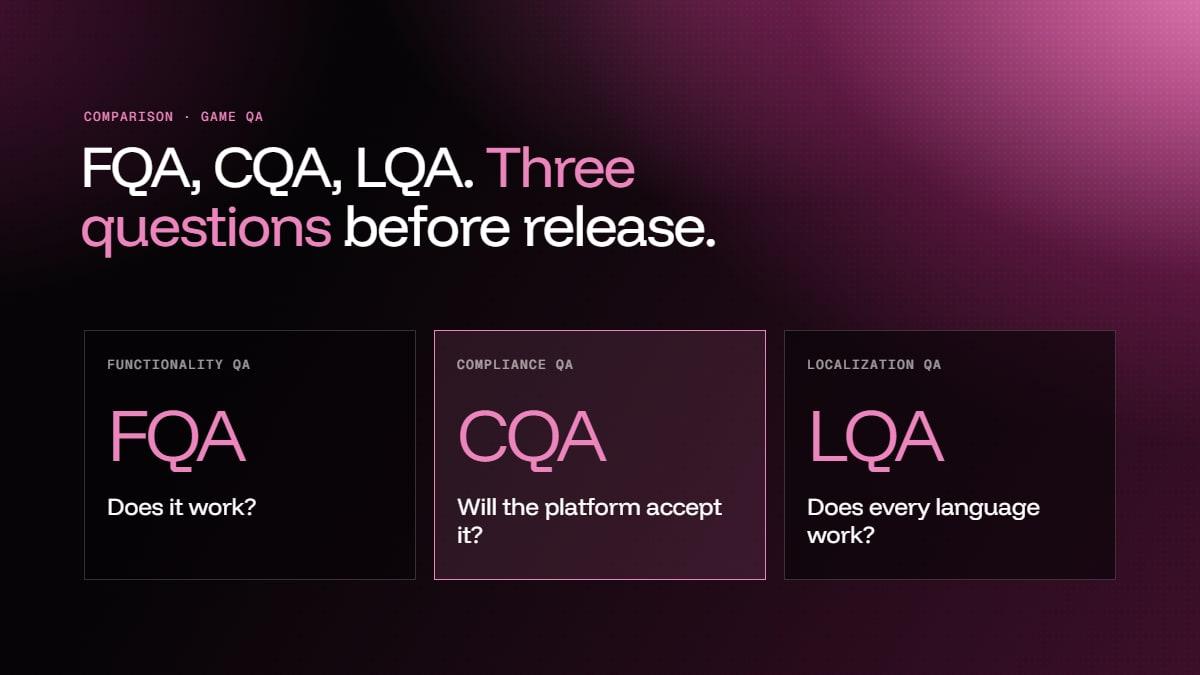
Short answer: FQA (functionality QA) checks that the game works, CQA (compliance QA) checks that it meets the platform holder's requirements, and LQA (localization QA) checks that every language reads and fits correctly in the game. A console port needs all three, at different moments: FQA from the first playable build, LQA once text and UI are stable, and CQA before every submission to certification.
The comparison
| FQA - Functionality QA | CQA - Compliance QA | LQA - Localization QA | |
|---|---|---|---|
| Question it answers | Does the game work as intended? | Will the platform holder accept it? | Does every language work in the game? |
| Tests against | The game's design and the original version | The platform's technical requirements | The source text, glossary and each market's conventions |
| Typical findings | Crashes, progression blockers, broken features, performance drops | Wrong system behaviour, save-data handling, suspend/resume, account and network errors, wrong platform terms | Truncated or overflowing text, missing translations, wrong context, font issues, untranslated buttons |
| When in a port | From the first playable build to release | Before every submission, and after big changes | When text and UI are stable, then on every text change |
| Who does it | QA testers who know the game | Testers who know the platform's requirements | Native-speaker testers working in the game |
| Cost of skipping it | Bad reviews, refunds, patches | A failed submission and a new certification round | Players in some markets get a broken or confusing game |
FQA: does it work?
Functionality QA is what most people picture as testing: play the game, break it, report it. In a port it has a specific job - comparing the new platform against the original. Every feature that worked on PC has to work on the console, with a gamepad, on that hardware, in docked and handheld mode if it's a Switch-family console. Regression tests after each fix make sure nothing that worked yesterday is broken today.
CQA: will the platform accept it?
Compliance QA tests the game against the platform holder's requirements: how it handles save data, user accounts, controller disconnects, suspend and resume, network loss, system features and the platform's own terms and button names. The detailed checklists are confidential and only available to registered developers, but the categories are well known - we describe them in Bugs that fail console certification and the technical requirements checklist guide. Good CQA means the submission passes the first time; skipping it usually means a certification failure and a new round.
LQA: does every language work?
Localization QA checks translations where players see them - in menus, subtitles, tutorials, item descriptions and store-required text. Translators often work from spreadsheets without seeing the game, so LQA catches what they couldn't: text that doesn't fit, lines translated out of context, missing characters in a font, and placeholder text left in the build. A port often adds languages or platform-specific text, so LQA is part of the plan, not an afterthought.
How they work together in a port
- FQA starts as soon as the first build runs on the target hardware.
- LQA joins when the UI and text are stable - usually after input and UI changes for the console are done.
- CQA runs before the first submission and again after any significant change.
- FQA and regression testing continue until the release build and through post-launch patches.
At LYNXBYTE GAMES all three are done in-house as part of the port, and certification is coordinated with the platform holders - see how we work.
Frequently Asked Questions
What is the difference between FQA and CQA?
FQA (functionality QA) tests whether the game works as designed - features, progression, stability and performance. CQA (compliance QA) tests whether the game meets the platform holder's technical requirements, such as how it handles save data, accounts, suspend and resume and network errors. A game can work perfectly and still fail compliance.
What does LQA mean in game development?
LQA stands for localization quality assurance. Native-speaker testers check every language inside the running game for truncated text, wrong context, missing translations, font problems and incorrect platform terms.
Do I need compliance QA before console certification?
Yes, if you want the submission to pass the first time. Compliance QA tests the build against the platform's requirements before it is submitted, so problems are fixed before the platform holder finds them.
When should LQA start in a game port?
Once the text and UI are stable, usually after the console UI and input changes are finished. Starting earlier means retesting the same screens after every UI change; starting too late leaves no time for fixes before submission.