You Asked, We Answered: Our October Q&A, Extended
The four questions studios and publishers ask us most often - how fast an estimate comes, why we need your source code, what happens if a port goes wrong and whether post-launch support costs extra - answered in full, with what to prepare and what to ask any porting partner.
 Przemysław ChmuraBusiness Development Representative
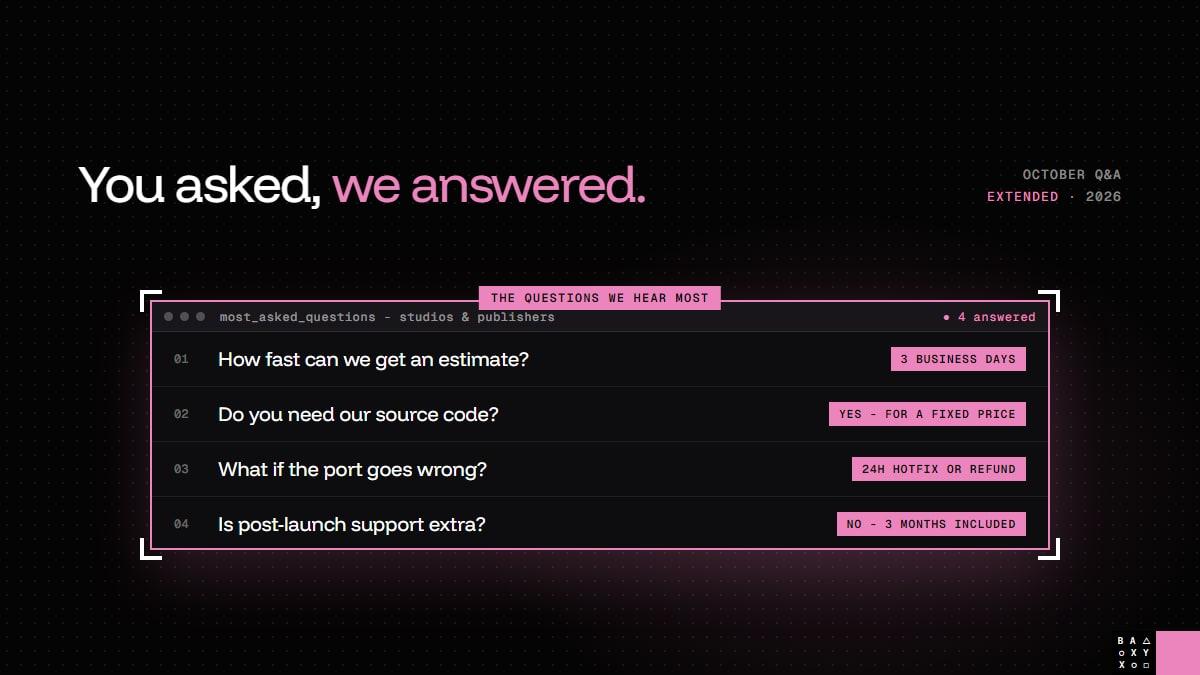
In October we ran a short Q&A on LinkedIn with the questions studios and publishers ask us most often. A social post leaves room for two sentences per answer. That is enough for the headline, but not for the part that actually helps you plan a port: why the answer is what it is, what you need to prepare, and what to check with any partner you talk to.
So here is the extended version - the same four questions, with the reasoning behind each answer.
1. How fast can we get an estimate?
Short answer: a ballpark within 3 business days - free and with no commitment. Then a repository review confirms the scope, the timeline and a fixed price.
There are two steps here, and it helps to know why.
The ballpark answers the first business question: is this port realistic, roughly what will it cost and how long will it take? To get there we need the basics - the engine and its version, the target platforms, your target date, and the game itself or its store page. You can send all of that through our estimate form. From that we can tell you which platforms look straightforward, where the obvious risks are, and what range you should plan around.
The repository review turns the ballpark into a number you can sign. Our engineers look at the repository, the build pipeline, controller readiness and performance, and confirm the scope, the delivery time and the fixed price. This is also the moment we tell you what is not in scope - so nothing in the final quote is a surprise later.
What speeds it up: a clear list of target platforms, a target release window, and the name of one person on your side who can answer technical questions. If the PC version is still changing, tell us - a frozen PC baseline makes the price easier to set, and ongoing PC work can be included in the scope from the start.
2. Do you need our source code?
Short answer: yes. Reviewing the repository and build pipeline is what makes a fixed price possible - we find the expensive surprises before the contract, not halfway through the port.
This is the question that makes people the most nervous, and that's fair. Your code is your company's most valuable asset. So let me explain what we actually do with it.
A port is not a recompile. The cost of a port lives in the details: a plugin with no console version, a save system written for one storefront, a menu that only works with a mouse, a scene that runs fine on a PC graphics card and at 20 FPS on a handheld. None of that is visible from a trailer or a Steam page. It is visible in the project.
Without the code, a porting company has two options. It can pad the price to cover risks it can't see - so you pay for problems you may not have. Or it can bill by the hour and discover the problems as it goes - so you pay for every surprise, and you only find out how much the port costs at the end. A repository review is the third option: find the problems first, then put a fixed price on them.
Who owns the code after the port? You do. You keep full ownership of your code - the port works on your game, it doesn't take it over.
What to prepare: access to the repository, the build instructions (or the person who knows them), and a list of third-party plugins and middleware you use. If the project hasn't been built in a while, that's useful to know too - it's one of the biggest mistakes we see in game ports when nobody checks it early.
3. What if the port goes wrong?
Short answer: if we miss the agreed timeline or the game gets 15%+ negative technical reviews at launch, a dedicated hotfix team is on it within 24 hours at no extra cost. If it can't be fixed, you get your money back.
Every porting partner promises to deliver. The difference is whether that promise is in the contract. Ours is: the guarantee is written into the agreement, not mentioned on a call.
It is triggered by three things: missing the agreed scope, missing the agreed timeline, or a launch where 15% or more of the reviews point at technical problems - crashes, performance, broken controls, save issues. The word technical matters. A port can't change whether players like a game's story or art style, but it is responsible for how the game runs on the new platform.
When the guarantee is triggered, there is no negotiation about who pays. A dedicated hotfix team - people who worked on the port - responds within 24 hours, and the work costs you nothing. If the problem can't be fixed in a way that meets what we agreed, you get a refund instead of a discount or an argument.
What it doesn't cover: changes to the agreement itself. New platforms added later, DLC, new modes, engine changes or big changes to the PC version after the baseline is agreed are new scope, and they get their own quote. I explain the whole process step by step in how "fix or refund" works in practice.
4. Is post-launch support extra?
Short answer: no. Bug fixes, patches and platform updates are covered for 3 months in every contract.
Launch is not the end of a port. The first weeks on a new platform are when players find the edge cases no test plan covered, when a platform update changes something under the game, and when the first patch has to go through certification again.
That's why post-launch support is part of every contract, not an add-on you negotiate after the first bug report. For 3 months after launch we handle bug fixes, patches, platform updates and certification upkeep, and it's the same team that built the port, so nobody has to learn your game from scratch in the middle of a launch.
If you plan to keep the game alive longer - regular updates, events, new content - that is a different kind of work. We cover it separately as live operations, scoped to what the game actually needs.
What to ask any porting partner
Whether you work with us or with someone else, these four questions are a good test of a partner. I'd add one follow-up to each:
- Estimate: "What happens between the ballpark and the final price - and what is excluded from the quote?"
- Source code: "What exactly will you review, and who owns the code after the port?"
- Things going wrong: "Is the guarantee in the contract, what triggers it, and who pays for the fix?"
- After launch: "How long is support included, what does it cover, and is it the same team?"
If a partner answers all of them clearly and in writing, you're in good hands.
Got a question we didn't answer?
Leave it in the comments under our LinkedIn posts - we'll pick the best ones for the next round. Or skip the queue and send us your game: you'll get a free first estimate within 3 business days, and you can ask us anything on the call.
Frequently Asked Questions
How fast can we get a game porting estimate?
LYNXBYTE GAMES gives a free, no-commitment ballpark estimate within 3 business days. A review of the repository and build pipeline then confirms the scope, the timeline and a fixed price.
Do you need our source code to port a game?
Yes. Reviewing the repository and build pipeline is what makes a fixed price possible: it finds the expensive problems - unsupported plugins, platform-specific code, performance gaps - before the contract instead of halfway through the port.
Who owns the source code after an outsourced port?
You do. With LYNXBYTE GAMES you keep full ownership of your code.
Is fixed-price game porting better than time and materials?
A fixed price moves the budget risk away from you: the scope, timeline and price are agreed after a technical review, so surprises found later don't turn into extra invoices. Time and materials only works well when the scope is genuinely unknown and you are ready to absorb the overruns.
What happens if a game port goes wrong?
If we miss the agreed scope or timeline, or the game gets 15%+ negative technical reviews at launch, a dedicated hotfix team responds within 24 hours at no extra cost. If the problem can't be fixed, you get your money back.
Is post-launch support included in a game port?
Yes. Bug fixes, patches and platform updates are covered for 3 months after launch in every contract, handled by the same team that built the port.
What is excluded from a game porting quote?
Changes to the agreed scope: new platforms added later, DLC, new game modes or features, engine changes and substantial changes to the PC version after the baseline is agreed. Each gets its own quote.