Your First Game Will Probably Be Bad. Make It Anyway.
Your first prototype won't look like the game in your head, and that is exactly how it should be. Why a rough first game is the best teacher there is, and how we help new creators get from that first build all the way through the paperwork of a real release.
 Krystian MlodziejewskiBusiness & Relations Director
Your first game will probably be bad. Make it anyway.
Your first prototype won't look like the game in your head. Your code won't be perfect. Your mechanics will change. Some ideas you love will end up on the cutting room floor.
That's not failure. That's game development.
I talk to a lot of developers, from first-time creators to studios with long catalogues behind them. The experienced ones almost never tell a story about the perfect idea that came out right on the first try. They tell stories about the games that didn't work - and what those games taught them.
Quick facts: Most first games fall short of the idea behind them, and that is normal: you learn game development by building, testing, breaking things and trying again, not by waiting for the perfect idea. Finishing a game also means a part nobody shows in tutorials - platform requirements, submission, certification and store pages. LYNXBYTE GAMES helps new creators with both sides, from the first prototype through development to release management and publishing support.
Your first prototype won't look like the game in your head
In your head, the game already has lighting, music, a finished world and a moment that gives players goosebumps. On screen, it starts as grey boxes.
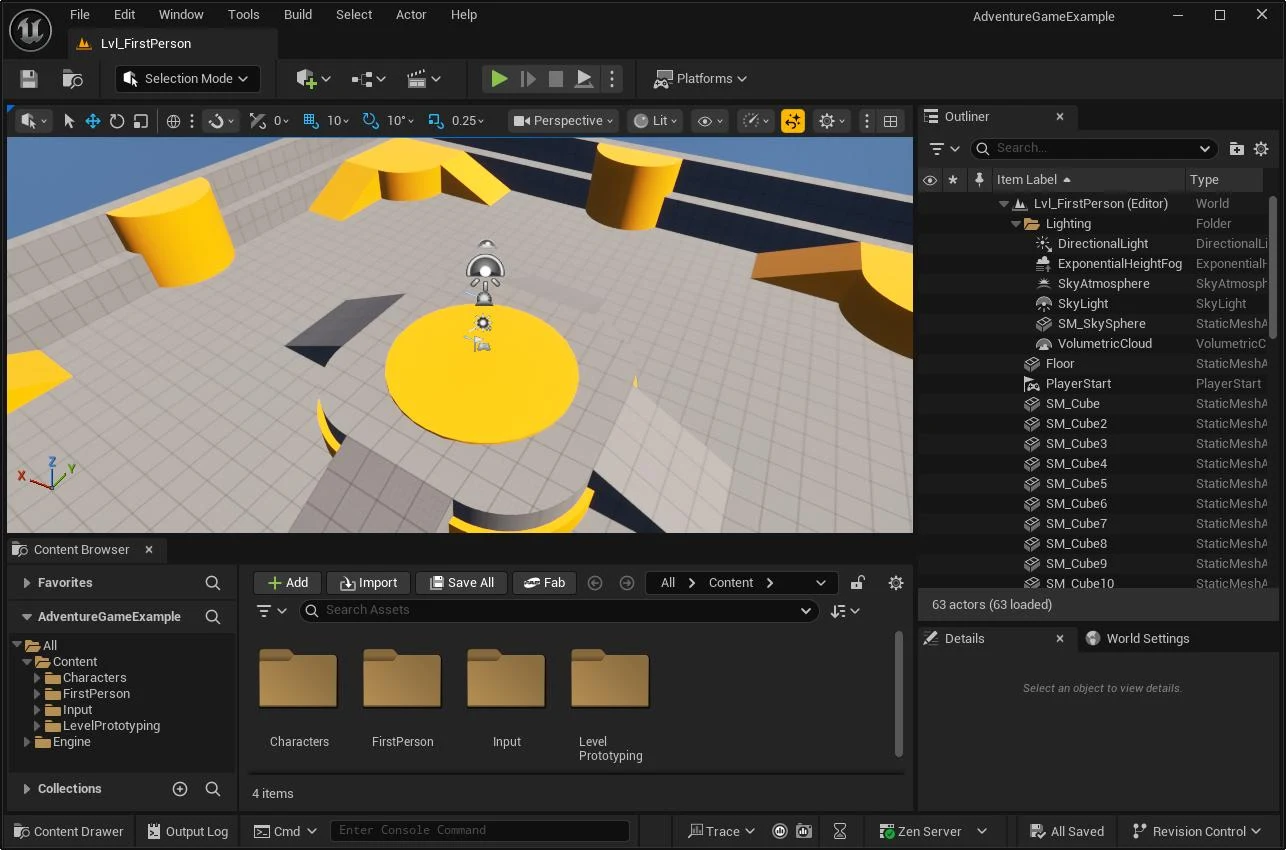
This is what a lot of games look like at the start: a blockout level in Unreal Engine, default lighting, placeholder shapes. Nothing here is pretty - and it doesn't need to be yet.
That gap between the picture in your head and the build on your screen is where most first projects stall. It feels like proof that something is wrong. It isn't. A prototype exists to answer questions - does this movement feel good, is this space fun to cross, does this mechanic hold up for more than five minutes - and grey boxes answer those questions faster than finished art ever could.
Why a bad first game is worth making
You don't get better by waiting for the perfect idea. You get better by building, testing, breaking things, and trying again.
Every part of a first game teaches you something you can't learn from reading about it:
- Scope. You will plan more than you can build. Cutting features you love - and noticing the game gets better for it - is one of the most valuable lessons in game development.
- Finishing. The last 10% of a game takes far longer than anyone expects: menus, settings, save systems, edge cases, bugs that only appear on someone else's machine.
- Iteration. Mechanics change once real people play them. Ideas that looked great on paper fall apart in testing, and small accidents turn into the best parts of the game.
- Your own process. How you organise a project, name things and keep a build working turns out to matter as much as any single feature.
None of that shows up in the first prototype. All of it shows up by the end of a first game - even a bad one.
The part nobody warns you about
Here is the other thing first-time creators discover: a working game is not the same as a released game.
Between "it runs on my PC" and "it's on the store", there is a whole layer of work most tutorials skip:
- Platform requirements. Every console has its own technical requirements, from how the game handles controllers and save data to how it behaves when the console goes to sleep.
- Submission and certification. Builds have to pass the platform holder's checks before they can launch, and a failed submission means fixing and resubmitting.
- Store pages and builds for players. Store listings, trailers, screenshots, a demo for festivals and wishlists.
- Release management. Coordinating dates, builds and updates across every platform you ship on.
This is the bureaucracy side of game development, and it is where a lot of good first games quietly stop. Not because the game wasn't ready, but because the path from finished build to released game was never explained.
How we help new creators, from the first build to the paperwork
This is a big part of what we do at LYNXBYTE GAMES. We work with experienced studios and publishers, but also with creators who are taking a game out into the world for the first time - and we help them with the whole path, not just one slice of it.
- Building the game. Our Full Development team can take a game from concept and first prototype through production, QA and launch, either as a full build or as a dedicated team working alongside you.
- Getting it onto more platforms. When the game works on PC, we port it to PlayStation, Xbox and Nintendo Switch 1 & 2 - and with Lynci, at a fixed price you know before the work starts.
- Release management and publishing support. We manage submission end to end and coordinate with platform holders directly, and we help with store pages, demos, certification and the rest of the release paperwork. See our additional services for the details.
- Someone to ask. You get a producer who always answers and a lead developer for technical questions - no account managers in between.
You don't have to know how certification works before you start. That's what we're for.
So make the bad game
Build the prototype that doesn't look like the game in your head. Ship the mechanic that turned out different than you planned. Cut the idea you loved. Finish it.
The first game teaches you how to make the second one. And when you're ready to take a game further than your own PC, get a free estimate or get in touch - we'll help with everything from the first build to the last form.
What did your first game teach you?
Frequently Asked Questions
Is it normal for a first game to be bad?
Yes. Most first games fall short of the idea behind them. Prototypes start as rough blockouts, mechanics change after testing and some ideas get cut. That process is how developers learn scope, iteration and finishing.
Should I wait for a better idea before making my first game?
No. You get better at game development by building, testing, breaking things and trying again, not by waiting for the perfect idea. A finished small game teaches more than an unfinished big one.
What comes after a game is finished?
Releasing on a store or console involves platform technical requirements, submission and certification, store pages, demos and release management across every platform you ship on.
Can LYNXBYTE GAMES help a first-time developer release a game?
Yes. LYNXBYTE GAMES helps new creators from the first prototype through full development, console porting, submission, certification and publishing support, with a producer and a lead developer as direct contacts.