How Do You Remake a Game Built on a Custom Engine?
Spoiler: you probably shouldn't rebuild the custom engine. Here's how we approach remaking older games - and five things we've learned along the way.
 Sylwester PilarzMarketing Specialist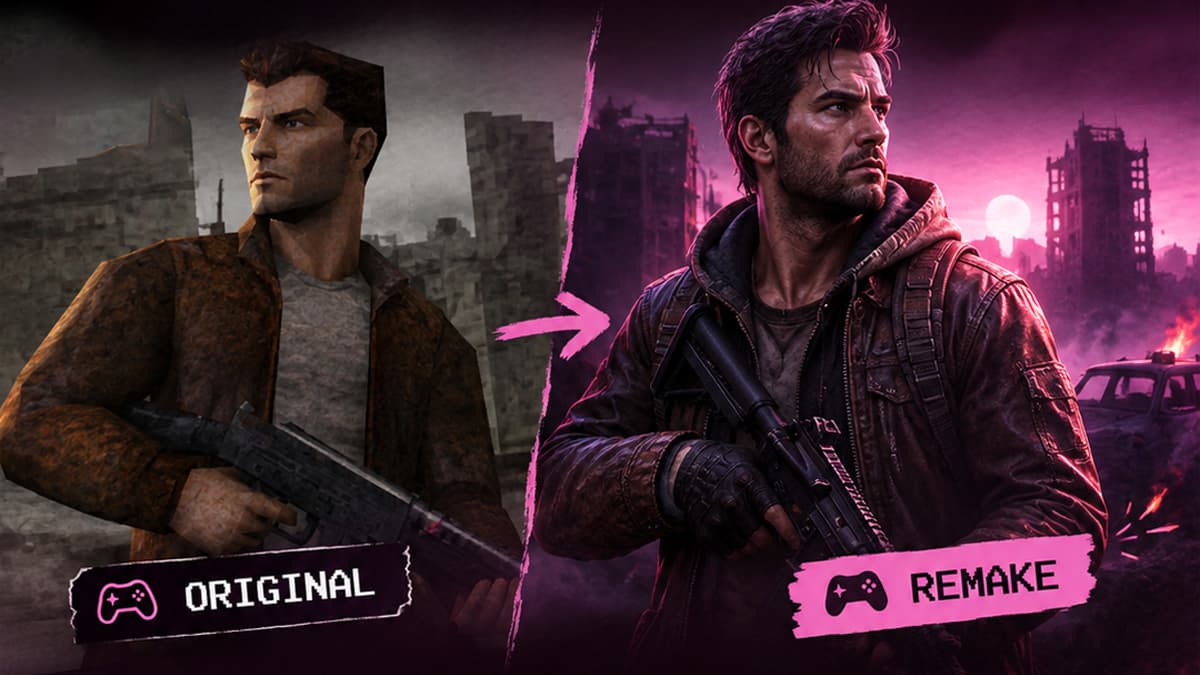
How Do You Remake a Game Built on a Custom Engine?
Spoiler: you probably shouldn't rebuild the custom engine.
When working with older games, one of the biggest challenges is often the technology behind them, not the game itself. Custom engine. Legacy tools. An outdated rendering pipeline. Platform-specific code written for hardware nobody ships anymore. Years of technical debt stacked on top of all of it.
And here's our approach: move the game to Unreal Engine.
That sentence is easy to write and genuinely difficult to do well. A remake is not simply about copying assets and rebuilding levels on newer tech. The real challenge is identifying what makes the original game what it is - gameplay systems, physics, AI, camera behavior, animation, level logic - and then rebuilding those systems using a modern, maintainable architecture.
Why not just keep the old engine?
It's tempting to treat the custom engine as sacred. It's what the original team built, tuned, and shipped a real game on. Surely the safest path is to keep it running and modernize around the edges?
In practice, that's rarely the cheaper option. Custom engines from ten or twenty years ago were built by teams that have often moved on, for hardware that no longer exists, using tools that stopped being maintained years ago. Every new platform, every modern feature, every hire who needs to get up to speed - all of it fights the same old architecture. The technical debt doesn't go away by working around it. It compounds.
Moving to Unreal Engine trades that debt for a foundation that's actively maintained, well documented, and already solves most of the problems a legacy engine forces you to solve yourself: rendering, platform abstraction, tooling, console certification requirements, and a hiring pool that already knows the engine.
The catch is that "move it to Unreal" is where the real work starts, not where it ends.
A remake is a specification problem before it's an engineering problem
Before any system gets rebuilt, it has to be understood. What is this game actually doing, moment to moment, that makes it feel like itself?
That question sounds simple and almost never has an obvious answer. The feel of a game lives in dozens of small, interlocking systems - how fast the character accelerates, how the camera lags behind a turn, how forgiving the hit detection is, how AI reacts a half-second late in a way that feels natural rather than broken. None of that is written down anywhere. It's encoded in the original build, and the only way to recover it is to study that build closely and rebuild it deliberately, not guess at it from memory or screenshots.
That reframes the whole project. A remake isn't graphics work with some code attached. It's reverse-engineering a design, one system at a time, and re-implementing it on a stack that can actually support it going forward.
Five things we've learned doing this
None of this is theoretical for us. Here's what consistently matters once a remake project is actually underway.
Don't start with graphics
It's tempting to lead with a hero shot - better lighting, higher-poly characters, a lush environment pass. It photographs well and it's satisfying to build. But it tells you nothing about whether the remake is actually working.
Reproduce the core gameplay loop first, with placeholder assets, gray-box levels, and no shaders to hide behind. If the game doesn't feel right when it's ugly, better textures will not save it - they'll just make the problem more expensive to notice and more expensive to fix.
Separate data from logic
Weapons, vehicles, enemies, items, ability tuning - none of it should live hard-coded inside gameplay logic. Extract it into data-driven systems: tables, assets, and parameters a designer can tune without recompiling anything.
This isn't just cleaner architecture. It's what makes iteration fast enough to actually find the feel of the original game instead of approximating it once and moving on. When "make the shotgun feel punchier" is a five-minute change instead of a code change and a rebuild, you iterate until it's right instead of until you run out of time.
Treat the original game as a specification
Opinions about how a game "felt" are unreliable, including the opinions of people who worked on it. Nostalgia rounds the edges off. The fix is to measure instead of guess: capture movement speed, acceleration curves, physics response, animation timings, camera FOV, input latency, directly from the original build, and rebuild against those numbers.
Small differences compound into something that reads as "close but off" - the exact failure mode a remake needs to avoid. Players may not be able to name what's wrong, but they'll feel it in the first five minutes.
Don't blindly reproduce technical limitations
Not everything about the original is worth preserving. Draw distances capped by 15-year-old hardware, animation choices made because the engine couldn't do better, AI behavior that's really just a pathfinding bug players learned to route around - those are constraints, not design intent.
The goal is to preserve the experience the original was going for, not the ceiling the original technology happened to impose on it. Knowing which is which is most of the judgment call in a remake, and it's usually a conversation, not a rule you can apply mechanically.
Build for the future
A remake is also a foundation, not just a one-time deliverable. Once a game is running on a modern, well-documented engine, it becomes realistic to plan DLC, ports to new platforms, live patches, and additional content in a way the original architecture never could have supported.
That's worth designing for from day one - systems built to be extended, not just systems built to match what already shipped.
The question that actually matters
The most important question in a project like this isn't:
"How do we recreate this old engine?"
It's:
"What parts of this game are essential, and what technology gives us the best way to preserve and evolve them?"
That's where moving from a custom engine to Unreal Engine can make a huge difference - not because Unreal is trendy, but because it removes the engineering constraints that were never part of the design in the first place, and leaves the team free to focus on the systems that actually make the game the game.
If you're sitting on a title built on technology nobody wants to touch anymore, get in touch - that's exactly the kind of problem we like taking on.